The Art of Chinese
Brush Painting
Updated:
2013-03-10
Chinese Brush Painting is done with the traditional Chinese painting tools in
accordance with the Chinese people's aesthetic standard and philosophy. As an
important part of traditional Chinese culture and the invaluable treasure of
Chinese nation, it has a long history and fine traditions in the field of art in
the world. And it has taken a distinctive course or attitude of its
own.
Okay
EDITED (from asia-art.net)
First, there is the Chinese brush.
Unlike the brushes used for watercolor painting in the West, Chinese brushes have
finer tips suitable for dealing with a wide range of subjects and for producing the variations in
textures, shades, and strokes required by different styles of painting or
calligraphy. Since the materials used for Chinese calligraphy and painting are
somewhat similar, developments in Chinese calligraphic styles and techniques can also be used in
Chinese brush painting.
In painting, the ancient Chinese emphasized the expressions of brushes and ink
(and colors.)
The ancients used the expression yu pi yu mo(to have brush, to have ink). These show the significance of the meaning for the two terms
pi(brush) and mo(ink).
The brush techniques so much emphasized in Chinese painting include not only line drawing but also the stylized expressions of shade and texture
(皴法點法 cunfa, pronounced Tsun Fa) and the dotting methods (皴法點法
dianfa pronounced ) used mainly to differentiate trees and plants and also for simple embellishment.
The brush strokes give the painting rhythm and beauty and depict the subject's outward and inner qualities. At the same time, they reveal the individuality and style of the painter himself.
taste, perspective >>>>
Second, there is the ink. Ink has been used in calligraphy and painting for over two thousand years. When the ink cake is ground on the painter's stone slab with fresh water, ink of various consistencies can be prepared depending on the amount of water used. Thick ink is very deep and glossy when applied to paper or silk. Thin ink appears lively and translucent. As a result, in ink-and-wash paintings it is possible to use ink alone to create a rhythmic balance between brightness and darkness, and density and lightness, and to create an impression of the subject's texture, weight and
coloring.
Third, there is paper or silk
Chinese painting may be done either on Chinese paper or silk.
Chinese Paper
The original paper (around 100 AD.) was made from many different materials including pulp, old fishing nets and bark. Modern paper is often machine
made???. It is classed??? in degrees of weight and amount of size used. The paper is very absorbent and the amount of size
??? alum in it will dictate the quantity of ink used for strokes on the paper. Different paper produce different results; some are rough and absorb ink quickly like a sponge, others have a smooth surface which resists ink. Chinese paper is
mistakenly known as rice paper in the West.
Chinese Silk
Before painting on silk, the silk should be treated with alum and glue before use. This method makes silk less absorbent than paper. Brushstroke is best shown on paper. Because of this reason and the paper's variety of texture and finish, paper quickly became favored by artists and calligraphers.
Fourth, there are the colors. There are differences in the use of color between Chinese painting and modern western painting. Chinese painting aim???
is not to express the various shades of color of the subject in relation to a fixed source of light, but to express the characteristics of the different subjects.
in a synopstic??? and philosophical approach.
For example, the adding of traces of brown or green to rocks, trees, leaves, grass and moss in a painting is used to reinforce the feeling of a particular season or state of the weather.
Composition and Space
Fifth, there are composition and space. Since the creative requirements of Chinese painting do not demand strict adherence to reality or to a particular angle of view or source of light, the painter has
more freedom in terms of artistic conception, structural composition, and method of expression. To give prominence to the main subject, it is quite permissible to omit the background entirely and simply leave it blank. At the same time, since the sizes and shapes of the spaces in the painting are different, the very absence of content can itself create rhythm and variety. Sometimes the variety and balance created in this way is further enriched by the addition of inscriptions in the empty space.
>>> calligraphic inscription of poems ( 題詩
) or colophons ( 題跋 ).
Chinese landscape painters’ aim is to depict the familiar mountains and rivers of China from the perspective of nature as a whole and on the basis of their understanding of the laws of nature. In artistic conception and structural composition, most landscape paintings create the impression that the scene is viewed from high in the air, as if seen through the eyes of a bird.
hyperbole and metaphor
With flower-and-bird paintings, sometimes a single flower hangs as if suspended in space, or the flowers and plants of different seasons appear together. Explained by one of the Ming painters, Wang
Fu ( 王紱, 1362-1416), as “likeness through unlikeness” and Qi
Baishi (, 1863-1957) as “subtlety of a good painting lies in its being alike and yet unlike the subject.” Chinese painters attach great importance to reality, science, space and time and yet manage to disregard them at the same time. The laws of these things must come second to the requirements of artistic creation and should not become shackles that bind artistic expression.
Calligraphy and Seals
One of the distinctive characteristics of Chinese painting is the use of inscriptions in poetry of calligraphy and of special seals as part of the painting itself. This was a major contribution made by scholar painters. Its significance lies in its ability to express the theme and artistic conception of the painting more clearly and deeply while, at the same time, giving great insight into the artist's individuality, emotions,
and views on art and life. In ink-and-wash paintings, the bright red seal adds a final touch of beauty. When preparing the inscription and seal, therefore, the Chinese painter, in addition to considering their content, has always given great thought to the placement, length and dimensions of the inscription and the positions of
the seals on the painting.
strict rules
The simplest inscription consists of the artist's name and the date. Sometimes the inscription could include the occasion for the painting and the name of the person for whom the painting was done. It could be about the subject and style of the painting. Quite often the artist might include a piece of poetry or a literary
allusion ( 文學典故 ). These are all followed by the artist's own seal.
The seals can be carved in stone. It can contain a name, poetical saying, a design or symbol which has a connection with the painting. The seals are pressed into a pot or tin of cinnebar paste, a scarlet red color, and are impressed onto the painting. The paste contains mercuric oxide, ground silk and oils. It required a careful stamp as it is rather permanent. When using red seal on a monochrome painting, it is said to be "adding the eye to the dragon".
Rules of Painting
"See the great in the small”
and
“See the small in the perspective of the great”
“Among those who study painting, some strive for an elaborate effect and others prefer the simple. Neither complexity in itself nor simplicity is enough.
Some aim to be deft, others to be laboriously careful. Neither dexterity nor conscientiousness is enough.
Some set great value on method, while others pride themselves on dispensing with method. To be without method is deplorable, but to depend entirely on method is worse.
You must learn first to observe the rules faithfully; afterwards, modify them according to your intelligence and capacity. The end of all method is to seem to have no method.”
Lu Ch'ai(Wang Kai), Master of Ch'ing Tsai T'ang, XVII-century
…If you aim to dispense with method, learn method
…If you aim at facility, work hard
....If you aim for simplicity, master complexity
Lu Ch'ai(Wang Kai), Master of Ch'ing Tsai T'ang, XVII-century
The Six Qualities of Painting
To display brushstroke power with good brushwork control
To posses sturdy simplicity with refinement of true talent
To possess delicacy of skill with vigor of execution.
To exhibit originality, even to the point of eccentricity, without violating the li(the principles or essence) of things.
In rendering space by leaving the silk or paper untouched, to be able nevertheless to convey nuances of tone.
On the flatness of the picture plane, to achieve depth and space.
"Lu Ch'ang",
quoted from an early XI-century work of biographies of painters of the Five Dynasties and Northern Sung Periods.
The Twelve Things to Avoid in Painting
To avoid is a crowded, ill arranged composition (composition)
Far and near not clearly distinguished (composition)
Mountains without Ch’i, the pulse of life
Referring not only to the need for pictorial vitality created by composition with a quality of spirit, particularly since mountains were symbols of life. Of the Yang(of Heaven and the Spirit)
Water with no indication of its source
The element regarded as a source of life and associated with the Yin.
Scenes lacking any places made inaccessible by nature(natural and logical)
Where man has ventured, paths are a sign of his presence and should naturally lead somewhere.
Paths with no indication of beginning and end
Stones and rocks with one face
The rock has 3 faces, referring to the third dimension and technical skill in rendering it .
Trees with less than four main branches
The tree has four main branches and is represented as having solidity, roundness, and unity
Figures unnaturally distorted
Emphasize fitness based on naturalness, contributing to the harmony of the parts and the whole of a painting. Figures not only should be undistorted but should be shown in action, their position and mood in tune with the rest of the painting and thus with the order of nature.
Buildings and pavilions inappropriately placed
Houses, pavilions, bridges, waterwheels, or boats, never overshadow other elements in the picture but contribute to its main theme, usually some aspect of nature rather than of human activity.
Atmospheric effects of mist and clearness neglected
Color applied without method
Mountains and water are not only the main structural elements in a landscape painting, but serve as symbols of the Yin and Yang. They are structural ideas, hence the significance of the term ShanShui (mountain water) for landscape pictures.
"Shih Erh Chi",
quoted from a XIII-century work by Jao Tzu-jan.
attention should be paid in the differences between pinyin and
Wade-Giles (W-G):
x (like W-G hs, pronounced like sh), q (like W-G ch’,
pronounced ch), c (like W-G ts’,
pronounced ts). So: pinyin xia = Wade-Giles hsia, pronounced “shya”;
pinyin Qing =
Wade-Giles Ch’ing , pronounced “Ching”; pinyin cun
=Wade-Giles ts’un, pronounced
“tsun.”
Note that a Chinese surname is always in front of a given name;
a Chinese name has a
different order from that of an English.
Characteristics
Unlike the western painting, the traditional Chinese painting has its
distinctive characteristics. It does not emphasize one-point perspective
and the change of light and colors on objects. It is free in describing the
objects, and lay more emphasis on the painter's sentiment and the overall
arrangement of the picture, so this is a good point that "the Occidental
painting is redivivous art, but Chinese painting belongs to expressionist
art".
By means of artistic expression, traditional Chinese Brush Painting can be
divided into elaborate-style painting, liberal-style painting, and the
elaborate-liberal-style painting. The elaborate-style painting is drawn and
colored orderly and meticulously with the painting brush, it uses an extremely
exquisite brushwork to describe the objects. Comparatively, the liberal-style
painting employs free and concise stroke and ink to describe the appearance and
spirit of the objects, and express the painter's sensation. it is highly
synoptical and its connotative artistic conception is not conveyed by the
overall, but the partial. Drawing the liberal-style painting, the painter is
required to put the painting brush to paper precisely, and his every stroke must
be skillfully and with high proficiency to express the spirit of the picture.
For the elaborate-liberal-style painting, it is an integrated application on the
techniques both of the elaborate-style painting and of the liberal-style
painting.
Chinese painting is characteristic in composition, stroke, ink, and color. It
does not follow the golden section method as in western painting. It can express
special artistic conception and personal sentiment of the painter though it
lacks proportion in length and breadth regardless of drawing the long volume or
the vertical scroll. At the same time, Chinese painting does not square with
western painting in the use of perspective. Commonly, the latter adopts
one-point perspective in composition. It is just something like taking a picture
with a camera. The scene taken by the camera lens is limited by the room because
of the camera is fixed in a point when taking the picture. However, Chinese
painting is not always fixed in a point and is not limited by the fixed field of
view either when a picture is drawn. Its point can be moved according to the
painter's perception and needs. And the sceneries both in sight and out of sight
are drawn by the painter. This perspective is called cavalier perspective or
multiple-point perspective.
??? The skill of using strokes and ink is an important part of the formation
of Chinese painting. Its strokes are stressed the varieties on thick and thin,
swiftness and slowness, with syncopated cadence, turning and breaking, square
and round to express the tactile sensation of the objects. In general, Chinese
painting uses ink is subtle in the combination of shade and light as entirely
shade or light is not good for conveying the spirit of the picture. Its shade
part looks wonderful but not mechanical and the light part is delicately
beautiful but not gloomy.
Chinese painting is particular in applying colors. Its colors most are from
natural mineral materials and the animal shell. They can bear all kinds of
weather and not fade ???, and they are often applied on the picture levelly.
This way of applying colors pursues the original colors of the objects, the
change of light and shadow is not often appears
Tools for Chinese Painting
The artistic expression of Chinese painting differs from that of western
painting because of its tools for painting. To draw a Chinese painting, the
writing brush, ink stick, Shuan Paper (usually sized with alum), and ink stone
are necessary. Especially for the Shuan Paper (rice
paper is a misnomer), it is the best tool for Chinese painting
because it has a nice texture to allow the writing and painting brushes, wet
with Chinese ink and held in a well-trained hand to move freely on it, making
strokes varying from shade to light, from real to imaginative.
Materials for Chinese painting
Generally, Chinese painting is drawn on the Shuan Paper. But in the fans,
porcelain, bowls and dishes you also find the beautiful Chinese pictures when
you shopping in the tourist shopping streets or eating in some special
restaurants. Besides, the Chinese pictures are also drawn on the silk, screens,
even on many ancient tombs' walls.
Shapes of Chinese painting
Chinese painting is diverse in its shapes. Except the mural, there are
traverse, vertical, square, round, and flat in shapes, it also differs in size
and length.
Combination of poem, calligraphy, painting and signet
Chinese painting shows the perfect union of poem, calligraphy, painting and
signet. Generally, many a Chinese painter is a poet as well as a calligrapher.
He often adds a poem on it personally and stamps his various seals on the
painting after he finishes it. The combination of the four makes the painting
look more integrated, perfect and beautiful, which can bring the appreciator an
aesthetic pleasure.
Mounting
Mounting a Chinese picture is for keeping and housing for a long time because
many a Chinese picture is drawn on the breakable Shuan Paper or painting silk.
The traditional Chinese mounting technique is diverse in forms but commonly the
picture is backed a piece of paper up, and then purfled with the ninon, silk or
paper. Compared with a not-mounted picture, the mounted picture is more
substantial, beautiful, and convenient for travel, collection, and appreciation.
Themes
According to the different delineative subject matters, the themes of the
traditional Chinese painting can be classified into three branches i.e. human
figures, landscapes, and flowers and birds. For example, the painting of ladies;
the painting of mountains; the painting of insects and fish belong to the three
branches respectively.
Learn to draw a simple traditional Chinese painting
Before you start your Chinese journey you can have a try here to learn how to
draw a chick in traditional Chinese painting, you may find some joy from it.
Indeed, if you want to learn more Chinese painting you can visit the Chinese
painting shops in the ancient city of Lijiang or those in the West Street in
Yangshuo because sometimes the artists draw pictures in their shops or on the
street. And if you want to appreciate or purchase some, you can look for the
galleries or painting shops in Guilin thru your local guide.
from
a website china-phoenix.net within Wiki
Chinese Brush Painting is the traditional pictorial art exerted in China for
more than four thousand years. Its roots take source in an original way of
thinking much older which stresses the unity of the man and cosmos and the
uninterrupted dynamism of this universe. More than representation of a form,
Chinese painting seeks to express the heart, the internal movement of the
beings.
Generally, Chinese Brush Painting is made up of one or more poems,
calligraphy, a painted image, and the seal(s) of the artist.
Various methods or techniques in Chinese Brush Painting include:
- Xie Yi technique ("To write the idea" or "to write
the intention") is characterized by a full layout and mainly uses the
principle of the range.
- Meticulous Style "Gong Bi technique" ("The careful
brush" or "the skillful brush") - often referred to as
"court-style" painting. Meticulous Style requires great care and
grace; the strict composition has fine elaboration. The effect is highly
decorative and is characterized by its delicacy and its precision in detail.
- Bai Miao technique ("Drawing the line") - draws only contours
with black ink. It is attached to Gong Bi as a prerequisite before painting
with colors.
- Mo Gu technique ("Without frame") is similar to Gong Bi, but it
does not draw contours.
- Shui Mo technique ("Water and ink") are a style of Xie Yi, but
only carried out with black ink, while exploiting the ranges. It is
generally easier as compared to Meticulous Style.

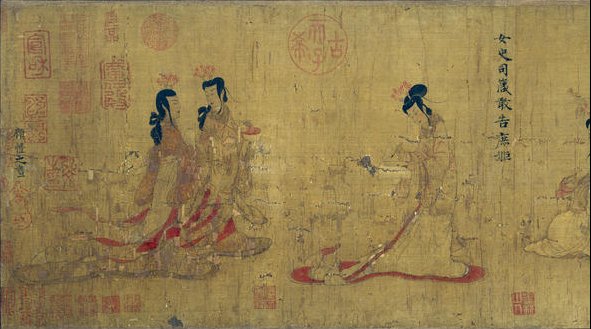
http://www.art-virtue.com/painting/history/wei-jin/GuKaiZhi/instructress.jpg
The Admonitions of
the Instructress to the Court Ladies (Gu
Kai-Zhi, c. 345-406)
This
oldest Chinese figure painting extant on paper and hand scroll is now
preserved at the British Museum. The painting was done using mostly Bai Miao technique ("Drawing the line")
with little color. |

Snow Scene in the Mountain Forrest by Fan Kuan (950-1032) in the Sung
Dynasty
His paintings were
regarded as "not only drawing mountains and backbones, but also
drawing the soul of mountains and snow." Fan
Kuan was listed as the 59th of the 100 most influential people of the
last millennium by the Life Magazine in 2004.
|
|
![2-5l[1].jpg (398932 bytes)](../project/2-5l1_small.jpg)
Immortal
in Splashed Ink by Liang Kai (fl. late 12th-early 13th
century) in the Sung Dynasty
Liang
was an early master of Shui Mo technique ("Water and ink").
In 1210, Liang was awarded the rank of Painter-in-Attendance at court, but he refused it. Instead, calling himself "Madman Liang", he spent his life drinking and painting. Eventually, he retired and became a Zen monk. Liang is credited with inventing the Zen school of Chinese
art and had a great influence on Zen art. The swift, smiling brush stroke composing
a seemingly drunk man embodies the Zen Buddhist philosophy of sudden
enlightenment.
|

Lee
Bai Strolling by Liang Kai (fl. late 12th-early 13th
century) in the Sung Dynasty
Liang's
simple strokes of the poet Lee Bai meditating and composing a poem
reflect the simplicity and directness of Zen philosophy.
|
|

Horse
by Lee Gong-Lin (1049 - 1106) in the Sung Dynasty
Lee
was famous in drawing many horses with Bai Miao technique - draws only contours
with black ink.
|

Landscape by Lee Tang (c. 1050-1130) in the Sung Dynasty
A typical Gong Bi "Meticulous Style" in landscape painting
of the Sung Dynasty court.
|
|
http://www.art-virtue.com/painting/history/sung/WildFlowersBlackRabbit.jpg
Rabbit (Anonymous) in the Sung Dynasty
A typical Gong Bi "Meticulous Style" in paining animals
commonly seen in court painting of the Sung Dynasty - the Golden Era of
Chinese Painting.
|
http://www.art-virtue.com/painting/history/sung/SparrowsPlumBlossoms.jpg
Sparrows and Plum Blossoms (Anonymous) in the Sung Dynasty
A typical Gong Bi "Meticulous Style" in paining animals
commonly seen in court painting of the Sung Dynasty - the Golden Era of
Chinese Painting. |
|
![lady-1[1].jpg (249416 bytes)](../project/lady-11_small.jpg)
Lady
by Pu Ru (1896 - 1963)
Meticulous Style
combined with slight Xie Yi technique "to write the idea" of a
figure by the mountain and a pine tree.
|

Night Party with Music Instruments by |
|

Lady
by Chen Sao-Mei (1909 - 1954)
Meticulous Style
with strict composition and fine elaboration in Chinese figure painting.
|

A
landscape study (draft) by Chen Sao-Mei (1909 - 1954)
Bai Miao
"Drawing the line" before painting
with colors.
|
Back
to Top
Tools
|
國畫顏料通常有兩種,使用起來會產生不同的效果: |
|
植物質的 |
如花青、滕黃、胭脂、牡丹紅等,性能是透明、質細,但年久會褪色。 |
|
礦物質的 |
如硃砂、朱漂、頭青至三青、頭綠至三綠、赭石、石黃、白粉等,性能是不透明,有覆蓋力,年久不褪色。 |
除文房四寶之外,印章、印泥、筆架、筆洗、筆筒、文鎮等相關繪畫用具尚有許多。
捲軸
是中國畫特有的,將字畫裝裱成條幅,下加圓木作軸,把字畫
捲卷軸 卷在軸外,以便收藏及攜帶。
中堂
客廳中間牆壁適宜掛上一幅巨大字畫,稱為「中堂」。
條幅
條幅可橫可直,橫者與匾額相類。無論書法或國畫,可以設計為一個條幅或四個甚至多個條幅。常見的有春夏秋冬條幅,各繪四季花鳥或山水,四幅為一組。
小品
就是指體積較細的字畫。可橫可直,裝裱之後,適宜懸掛較細牆壁或房間,十分精緻。
鏡框
將字畫用木框或金屬裝框,上壓玻璃或膠片,就成為壓鏡。
扇面
將摺扇或圓扇的扇面上題字作畫取來裝裱,可成壓鏡。由於圓形或扇形的形式美麗,亦有人將畫面剪成扇形才作畫,然後裝裱,別具風格。
冊頁
將字畫裝訂成冊。
長卷
將畫裱成長軸一卷,成為長卷,多是橫看,其畫面連續不斷。
斗方
將小品裝裱成一方尺左右的字畫,成為斗方。可壓鏡,可平裱成捲軸。
屏風
有單幅或摺幅,坐立於地,作屏風之用。
|
國畫的分類 |
|
按內容分: |
按技法分: |
|
山水畫
人物畫
花鳥畫
|
工筆畫
寫意畫
小寫意畫
大寫意畫
重彩畫
水墨畫
白描畫
敦煌壁畫 ???
|
按內容分:
山水畫
人物畫
花鳥畫
按技法分:
工筆畫
寫意畫
小寫意畫
大寫意畫
重彩畫
水墨畫
白描畫
敦煌壁畫
Five
Levels:
brushstroke
-soul and spirit
composition
color
spirit
consonance ( 神韻 )
意境
Contrast:
Susan
Tadlock: draw eyes first
Gu
Kai-Zhi: last
Zhang
Da-Chian: lips first...
Van
Gogh's influence page 355
The
Five Ingredients of Chinese Brush Painting
1. A solid foundation in Chinese
calligraphy
The
techniques and strokes of Chinese calligraphy can be applied to Chinese brush
painting. If a beginner does not have a good foundation in Chinese calligraphy,
he will definitely spend a lot more time to achieve the same results in Chinese brush painting than a beginner with a good foundation in
Chinese calligraphy. If a student has a strong foundation in Chinese calligraphy,
she will need less time to practice the strokes in painting and her success in
Chinese brush painting is guaranteed.
Furthermore, if a painter does not do good Chinese calligraphy, he will need to
ask someone else to sign and/or inscribe a poem in good Chinese calligraphy for
his work. Otherwise, if he inscribes or signs by himself, the painting will be
mocked and become less valuable. For example, two Chinese painting masters, Chang Da-Chien and Pu Hsin-Yu http://art-virtue.com/painting/ching/PuRu/bio-PuRu.htm
, were very knowledgeable of Chinese classical literature, poems, and
scriptures. They inscribed their beautiful poems onto their painting works.)
The study of philosophy is very important to Chinese calligraphers and
painters. It will make the work conveying more impressive effects to the viewers
and viewers may feel ... the special meaning conceived in the art???
GOOOGLE Keyworkd
A good Chinese brush painting work need beautiful poems written in Chinese
calligraphy and seals designed with good Chinese calligraphy in Seal Style. The
stamping and position of seals on a Chinese painting work are also very, very
important. If the seals (just like the inscriptions of poems in Chinese
calligraphy) on a Chinese painting work are not good enough to match the
painting, the painting will be demeaned.
The
difference between Chinese brush painting and Western painting. He also
mentioned the five important ingredients of a good Chinese brush painting work:
Many
Westerns: not dark, masculine enough, not enough color or perspectives lack of
understanding of Chinese philosophy Zhang's praise of Pu Ru soft but also robust
http://www.youtube.com/watch?v=hwCY3u47jpQ
for landscape
Next
Nae Rae


![2-5l[1].jpg (398932 bytes)](../project/2-5l[1].jpg)


![lady-1[1].jpg (249416 bytes)](../project/lady-1[1].jpg)